The Quiet Hour Is Becoming a City’s Most Valuable Amenity
Ninety minutes a day without traffic was meant as a summer experiment. Three years on, it is the most contested piece of land-use policy in the city.
The first thing you notice is not the silence. It is that you can hear the same sounds you always could — a shop shutter, a bicycle bell, somebody counting change — and that they arrive one at a time instead of all at once.
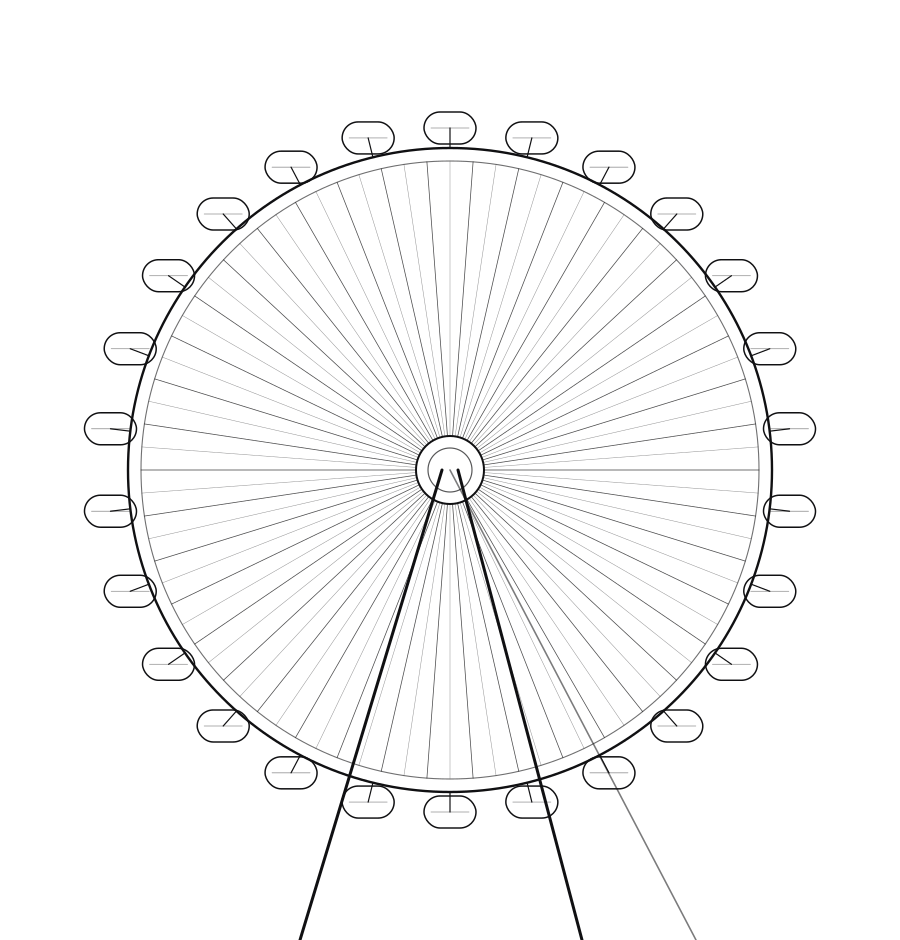
At half past four each afternoon, six streets around the old fish market close to through traffic for ninety minutes. Delivery vans that have not cleared the cordon wait at the edge. Buses are rerouted two blocks north. The observation wheel stops turning. Then, at six, everything starts again.
It was supposed to last one August. The transport department wrote it as a noise-abatement trial with a four-page evaluation plan and no budget to speak of. Nobody involved expected it to survive its own paperwork.
The trade nobody predicted
What made it survive was the receipts. Merchants along the cordon had objected loudly in the consultation — closing a street to vehicles in the busiest month of the year read to them as a straightforward loss. The first summer’s figures said otherwise, and they said it clearly enough that the objection collapsed.
People did not spend more per visit. They stayed longer, and they came back. The bakery on the corner moved its closing time back by an hour and hired a second afternoon shift. Two streets over, a hardware shop that had been listed for sale took itself off the market.
“We assumed we were selling convenience. It turned out we were selling somewhere people were willing to stand still.”
— A merchants’ association representative, speaking at the third-year review
Where the argument actually is
The dispute now is not about whether the quiet hour works. It is about who it works for, and that turns out to be a much harder question to answer with footfall data.
- Residents of the cordon streets report the largest gains — and they were already the least likely to be affected by traffic noise indoors.
- The rerouted bus corridor runs through the two districts with the lowest car ownership in the city.
- Shift workers arriving between four and six have no equivalent concession; the scheme is built around the rhythm of people who choose when to be there.
None of this is fatal to the policy, and none of it appears in the evaluation that four other councils have now copied. That is the part the transport committee has been asked to look at again before the scheme is made permanent.
What gets copied
A policy that spreads is rarely the policy that was written. What the other councils adopted was the cordon and the ninety minutes. What they mostly left behind was the monitoring — the door counters, the dwell-time survey, the quarterly published dataset that made the first summer arguable in the first place.
Which leaves the city in an unfamiliar position: it has produced the most-imitated street-level intervention in the region, and it is the only place still collecting enough evidence to find out whether it was a good idea.
This is a design demonstration. News Daily US is not a real publication; the reporting, quotations, figures and bylines on this page are invented for layout purposes and should not be read as fact.